


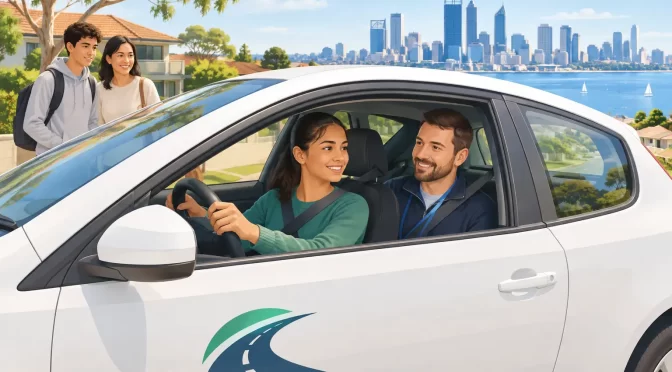
A learner edges towards a busy Cockburn roundabout, checks the gap, then hesitates. In that moment, the choice between dual control versus private car lessons becomes more than a question of convenience or cost. It affects how safely a learner can practise difficult decisions, how quickly mistakes are corrected, and how confident everyone feels getting back on the road.
Private practice with a parent, sibling or friend can be valuable. It gives learners the kilometres they need to become familiar with the car and build routine. Professional lessons in a dual-control vehicle add another layer: a qualified instructor who can coach in real time and intervene if a situation becomes unsafe.
The strongest approach is rarely one or the other. For most learner drivers, it is a thoughtful combination of both.
Dual control versus private car: the practical difference
A dual-control car has an additional brake pedal for the driving instructor. The learner remains in the driver’s seat and makes the driving decisions, but the instructor can brake if there is an immediate risk – for example, if the learner misses a hazard, misjudges a gap or approaches an intersection too quickly.
That extra brake is not there to take over every time a learner feels unsure. Good instruction is about helping the learner observe, plan and respond independently. Dual controls simply provide a safety margin while the learner is building those skills in traffic, on higher-speed roads, around complex intersections and when parking in tighter spaces.
A private car does not have that backup. The supervising driver can give directions, remind the learner to slow down and help them think ahead, but they cannot physically prevent an error once the vehicle is moving. This means private practice often works best when the route and conditions match the learner’s current ability.
Neither option automatically creates a safe driver. A dual-control vehicle is only as useful as the instructor’s ability to identify the real cause of a mistake and explain how to fix it. Likewise, private practice can be excellent when the supervisor is calm, consistent and prepared to follow current Western Australian road rules.
Why dual controls help learners progress safely
Early lessons involve more than steering and braking smoothly. Learners are developing hazard perception, gap selection, observation habits, road positioning and judgement. These skills take time because the learner must process several things at once while still controlling the vehicle.
In a dual-control lesson, the instructor can choose appropriate routes and gradually increase the challenge. A learner might begin with quiet local streets, then practise traffic lights, roundabouts, lane changes, busier shopping areas and higher-speed roads as their control improves. If they make a serious error, the instructor has a way to manage the immediate risk while explaining what happened afterwards.
This can reduce the fear that sometimes affects both learners and parents. A nervous learner may avoid practising challenging situations because they are worried about getting it wrong. A nervous parent may keep giving rushed instructions, grab at the handbrake or avoid busy roads altogether. Neither reaction is a failure, but it can limit useful practice.
Dual controls also allow an instructor to give precise technical feedback. Rather than saying, “You need to be more careful,” a qualified instructor can identify whether the issue was a late mirror check, poor scanning at an intersection, braking too late, incorrect road position or a failure to recognise another road user’s intention. Specific correction gives the learner something repeatable to work on next time.
For families, vehicle condition and insurance also matter. A professional school vehicle is maintained for instruction, fully insured for lessons and designed to be used by learners. At Drive Solo, lessons are delivered in dual-control, 5-star ANCAP-rated automatic vehicles, so learners can focus on developing safe habits without placing additional pressure on the family car.
Where private-car practice has real value
Professional lessons alone are not usually enough to make driving feel natural. Learners need regular time behind the wheel to turn coaching into habit. That is where private practice can make a meaningful difference.
A familiar family car lets a learner practise the basics repeatedly: moving off smoothly, approaching familiar intersections, reversing into the driveway, maintaining a safe following distance and reading the traffic on routes they will use for school, work or sport. Short, regular drives are often more effective than waiting weeks between long sessions.
Private practice can also help learners become adaptable. Every car feels slightly different. The brake response, steering weight, mirror position and visibility may not match the instructor’s vehicle. Driving safely includes taking a moment to set up the seat and mirrors, understand the controls and adjust smoothly to the vehicle being used.
The limitation is that informal teaching can unintentionally pass on old habits. Many experienced drivers have developed shortcuts over the years, such as incomplete head checks, rolling through a stop sign, following too closely or using a different method at roundabouts. These behaviours may feel normal to an experienced driver but can create safety issues and may not meet the standard expected in the WA Practical Driving Assessment.
Private supervisors do not need to be perfect. They do need to be patient, legal to supervise, focused on the road and willing to keep instructions calm. If a session is becoming stressful, it is usually better to stop, discuss one key improvement and try again another day rather than letting frustration become part of the learner’s driving experience.
The assessment difference: practise driving, not just the test route
Learners preparing for the WA Practical Driving Assessment often ask whether a private car or an instructor’s car is better for test preparation. The answer depends on the learner’s confidence, the condition of the private vehicle and how much support they need on the day.
A professional instructor understands the current assessment expectations and can help a learner practise the behaviours assessors observe: safe decision-making, correct observation, speed management, positioning, manoeuvres and responses to changing traffic conditions. The aim should not be to memorise a route. A safe driver needs to perform consistently wherever the assessment takes them.
Using the same dual-control vehicle for lessons and the test can reduce one source of uncertainty. The learner already knows the controls, reference points and feel of the car. A complete test-day arrangement can also include a warm-up lesson, vehicle hire, insurance cover and transport, which removes practical stress for families.
That said, a learner who has done plenty of supervised practice in their own car may prefer taking their assessment in that vehicle. It must be roadworthy, suitably insured and meet the licensing requirements. The learner should be genuinely comfortable in it, not simply choosing it because it is available.
Cost, confidence and the best balance
Private practice is generally the lower-cost way to accumulate driving experience, particularly once a learner has been shown what good driving looks like. Professional lessons cost more per hour because they include a licensed instructor, dual-control vehicle, structured coaching, fuel, insurance and lesson planning.
The better question is not which option is cheapest for a single hour. It is which option helps the learner improve safely. Repeating an incorrect habit for months can be harder and more expensive to correct later. On the other hand, relying only on paid lessons without enough practice between them can slow down progress.
A balanced plan might use professional lessons to introduce new or difficult skills, identify patterns that need correcting and prepare for the PDA. Private practice can then reinforce those exact skills in lower-pressure situations. After a lesson on roundabouts, for example, a parent can ask the learner to explain their approach aloud: check mirrors, choose the correct position, scan for hazards, give way where required and enter only when the gap is safe.
Progress reports can make this partnership easier. When learners and parents know what was covered, what improved and what needs more work, private practice becomes purposeful rather than a vague drive around the suburb.
Choosing what your learner needs now
Dual-control lessons are particularly useful when a learner is brand new, anxious in traffic, returning after a long break, unfamiliar with WA road rules or struggling with repeated mistakes. They are also valuable before the PDA, when detailed feedback and realistic assessment practice can make confidence more reliable.
A private car is ideal for reinforcing skills between lessons, building logged experience and making driving part of normal life. Start with conditions the learner can manage, then add complexity gradually. Wet weather, night driving, peak-hour traffic and unfamiliar areas can be worthwhile practice, but only when the learner is ready and the supervisor can remain calm.
The goal is not to get through lessons as quickly as possible. It is to help a learner make safe choices without being prompted, whether they are driving a familiar route with a parent beside them or handling an unexpected situation alone after they are licensed.
