


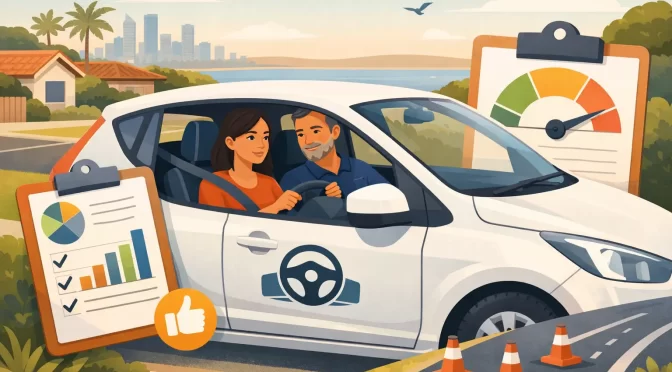
A learner driver progress report should do more than say whether a lesson went well. It should show exactly what a learner can do safely, where errors are still happening and what to practise before the next drive. For parents, it replaces guesswork with a clear view of progress. For learners, it turns feedback into achievable steps rather than a vague instruction to “be more confident”.
Learning to drive is not simply about accumulating hours or memorising the route to a test centre. It is about building safe decisions that still hold up when traffic is busy, visibility changes or another road user makes an unpredictable move. A useful report makes that development visible.
What a learner driver progress report should include
The best progress reports are specific. “Needs more practice” may be true, but it does not tell a learner what to change. Clear feedback identifies the driving skill, the situation where it happened and the action required next time.
For example, a report may show that a learner is comfortable with basic vehicle control but needs to improve observation before changing lanes. That means checking mirrors early, using the indicator with enough notice, completing a head check and only moving when there is a safe gap. The learner now has a sequence to repeat, not just a criticism to worry about.
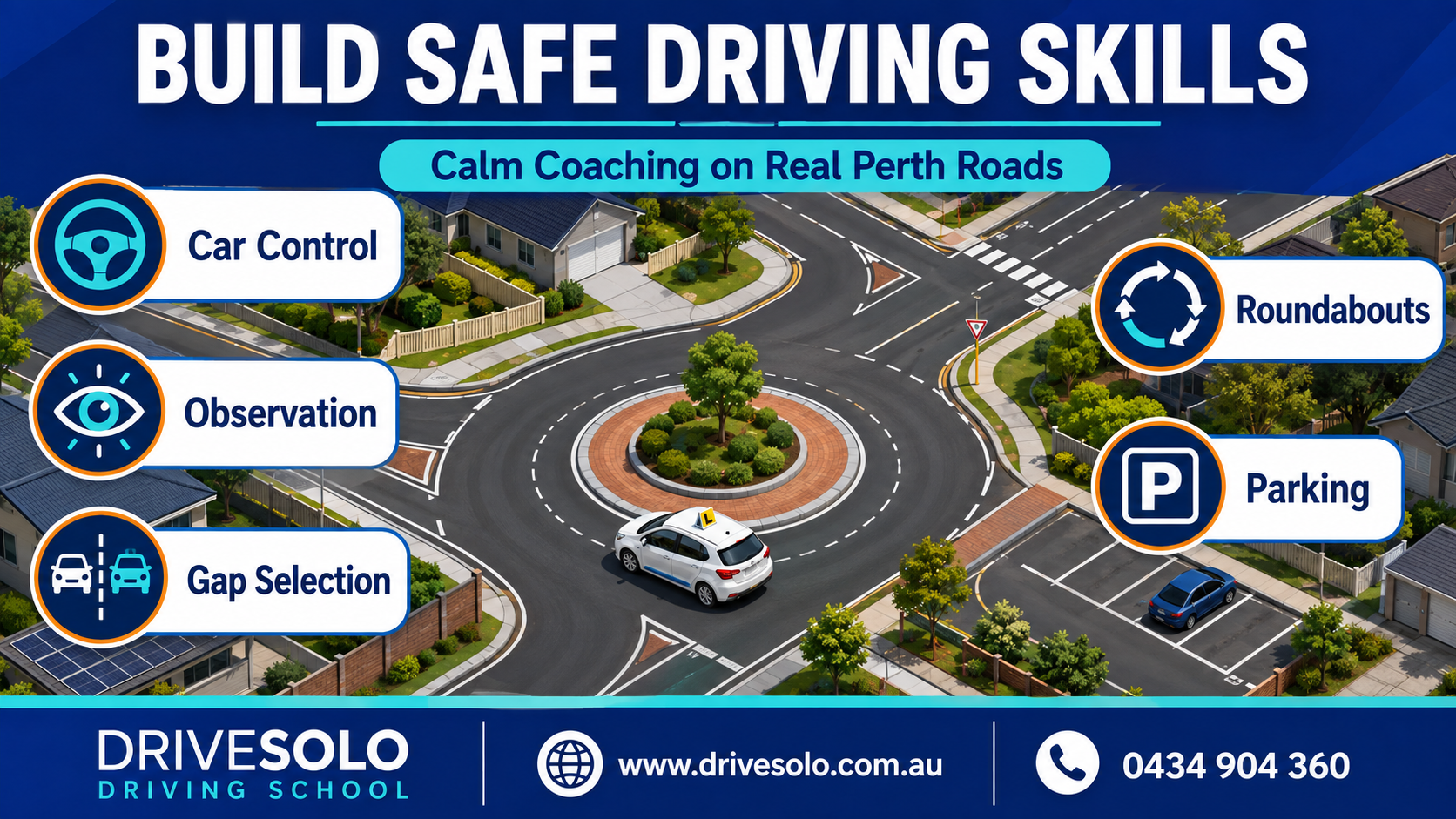
A thorough report generally tracks progress across the practical skills that matter on Western Australian roads and in the Practical Driving Assessment (PDA). These include vehicle set-up and controls, moving off and stopping, steering, speed management, scanning for hazards, gap selection, lane changes, turns, roundabouts, reversing, parking, intersections and responding to signs and road markings.
It should also record driving behaviours that are easy to overlook but critical for safety. Is the learner planning ahead rather than braking late? Are they checking for cyclists before opening a door or moving left? Do they recognise when a following distance needs to increase in rain, at night or in heavier traffic? These are the habits that help a newly licensed driver manage real roads independently.
Why progress tracking matters more than counting lessons
Every learner progresses at a different pace. One person may master parking quickly but find busy roundabouts stressful. Another may be calm in traffic yet need extra work judging stopping distances or holding a steady speed. Counting lessons alone does not reveal whether the important skills are developing.
A progress report helps make each lesson part of a plan. Instead of repeating familiar routes because they feel comfortable, the instructor can introduce the right level of challenge at the right time. That could mean quiet residential streets first, then shopping precincts, multilane roads, school zones, night driving or more complex intersections.
This approach also prevents a common problem: learners becoming capable in only one set of conditions. Someone who has driven mostly on calm weekend mornings may feel very different during an afternoon peak, on wet roads or when navigating an unfamiliar area. Safe driving confidence comes from experience and sound judgement, not from avoiding every difficult situation.
For parents and supervising drivers, reports can make home practice more productive. Rather than trying to cover everything in one drive, choose one or two focus areas from the latest feedback. If the report identifies late mirror checks, practise a calm routine: mirrors, signal, head check, move when safe. Repetition in varied conditions helps turn that routine into an automatic habit.

The difference between confidence and readiness
Many learners feel confident before they are consistently ready to drive alone. Others are capable but underestimate their ability because a recent mistake has rattled them. A quality report separates feelings from demonstrated skills.
Readiness is not about a perfect drive. Even experienced drivers make minor errors. It is about whether the learner notices risks early, makes legal and safe choices, recovers calmly from small mistakes and avoids creating danger for other road users.
A learner who takes a wrong turn but continues safely may be showing good judgement. A learner who suddenly changes lanes because they are worried about missing a turn needs more practice with planning ahead. This distinction matters in the WA PDA, but it matters even more after the licence is issued.
The report should recognise improvement as well as flagging gaps. Seeing that roundabouts have moved from “requires guidance” to “usually independent” gives learners evidence that their effort is working. Constructive progress tracking builds confidence without giving false reassurance.
How reports support practical driving assessment preparation
Preparing for the PDA should not mean teaching a learner to perform a memorised test routine. Assessors are looking for safe, lawful driving, effective observation, sound vehicle control and decisions that suit the road conditions. These are the same skills a driver needs after passing.
A progress report can indicate when a learner is ready to shift from foundational instruction to assessment preparation. At that point, feedback may focus on consistency: completing checks without prompts, maintaining appropriate road position, responding to directions calmly and dealing safely with unfamiliar roads.
It can also identify the issues most likely to affect an assessment result. Common examples include incomplete head checks, failing to give way correctly, travelling at an unsuitable speed, hesitation that disrupts traffic, poor observation at intersections or losing control during a reversing manoeuvre. The goal is not to frighten the learner with a list of faults. It is to correct each issue methodically before test day.
A good instructor will explain why an error matters. A missed head check is not just an assessment concern – it can mean missing a motorcyclist, cyclist or vehicle in the blind spot. When learners understand the safety reason behind a technique, they are more likely to use it consistently.
What parents should look for in feedback
Parents do not need to become driving instructors, and trying to correct every detail during a practice drive can overwhelm a teenager. Their most valuable role is to provide calm, regular practice and reinforce the agreed focus areas.
Look for feedback that is balanced, measurable and easy to act on. It should show what the learner did well, what needs attention and what conditions will be useful for the next stage of practice. If a report continually uses broad phrases without examples or a practice direction, ask for clearer guidance.
It is also reasonable to expect the report to change as the learner develops. Early lessons may concentrate on steering, braking smoothly and understanding road position. Later feedback should cover hazard perception, independent decision-making and handling more demanding traffic environments. A report that stays generic cannot provide a reliable picture of readiness.
Families in Perth often manage lessons around school, work and other commitments, so a written record is particularly useful when more than one person supervises practice. It keeps everyone working towards the same safe routines instead of offering conflicting advice based on old habits or personal preferences.
Turning feedback into better practice between lessons
The most effective practice drives have a purpose. Before leaving, review the latest feedback and agree on one primary skill. During the drive, keep instructions short and timely. Afterwards, discuss one success and one area to work on next time.
If the report shows difficulty at roundabouts, start on smaller, quieter roundabouts before progressing to busier locations. If speed control needs work, practise recognising changing limits and choosing a speed that matches traffic, weather and visibility. If parking is the challenge, repeat the same manoeuvre enough times to understand the reference points, then practise in different car parks so the skill does not depend on one familiar bay.
Avoid practising when the learner is tired, rushed or upset. Challenging situations are valuable, but only when the learner has enough capacity to learn from them. A patient, structured approach is safer and usually leads to faster improvement.
At Drive Solo, learner reports are used to give each driver and their family a clear picture of the skills being built, the corrections that matter and the next practical step towards safe independent driving.
A report is a safety plan, not a scorecard
A learner driver progress report should never be used to compare one learner with another. Its value is in showing individual development over time. Some drivers will need more practice before they are ready for complex traffic or the PDA, and that is a responsible outcome, not a setback.
The right report makes the path forward clearer: practise the specific skill, build consistency in different conditions and only move on when the behaviour is safe and repeatable. That gives learners a stronger chance of passing their assessment, but more importantly, it gives them a better foundation for the first solo drive after the licence is in their wallet.
