



A full licence from another country can mean you are already an experienced driver. It does not always mean Perth roads will feel familiar on your first day behind the wheel. Driving lessons for overseas drivers Perth residents rely on are designed to close that gap safely – without treating you like a complete beginner or assuming that overseas habits will transfer automatically.
For some drivers, the biggest adjustment is driving on the left. For others, it is understanding roundabouts, school zones, give-way rules or the way Western Australian assessors expect safe driving decisions to be shown. Focused professional lessons give you time to practise these skills in real traffic, receive clear correction and build habits that hold up well beyond test day.
Why overseas driving experience is only the starting point
Drivers arriving in Perth often have strong vehicle control. You may have driven for years in busy city traffic, on motorways or in difficult weather. That experience matters. It can help you learn local road conditions quickly and make thoughtful decisions around other road users.
However, safe driving is not only about controlling a car. It is also about reading the road according to local rules and local expectations. A decision that was normal in your home country may be unsafe, illegal or misunderstood here. This is especially relevant at intersections, when merging, around cyclists and pedestrians, and in lower-speed suburban streets where hazards can appear quickly.
There is also a practical licensing question. Whether you can drive on an overseas licence, need to sit a theory test, or need to complete a Practical Driving Assessment can depend on your visa status, the country that issued your licence and how long you have been in Western Australia. Requirements can change, so it is sensible to confirm your personal situation with the relevant WA licensing authority before making assumptions.
If you do need to prepare for a WA practical test, previous driving experience does not guarantee a pass. The assessment looks for safe, legal and repeatable actions. An instructor can identify the small habits that may be costing you marks before they become test-day mistakes.
The Perth road rules that usually need the most practice
Keeping left is more than changing sides of the road
Drivers from right-hand traffic countries need to retrain more than steering position. Lane placement, mirror checks, turning paths and where you look at an intersection can all feel reversed at first. Right turns require particular care because you cross opposing traffic, while left turns can place you alongside pedestrians, cyclists and vehicles travelling in the same direction.
It is common to understand the rule but still drift into an old pattern under pressure. That is why practice should start in quieter streets, then progress to busier routes, multi-lane roads and complex intersections. Repetition matters. The aim is for correct positioning and observation to become natural, not something you have to remember at the last second.
Roundabouts require early planning
Roundabouts can feel straightforward until there are several entry points, multiple lanes or heavy traffic. In Perth, you need to approach at an appropriate speed, choose the correct lane early, give way correctly and indicate as required when leaving. You also need to watch for vehicles entering from other directions, pedestrians near crossings and cyclists who may be less visible.
A common issue for experienced overseas drivers is entering too quickly or concentrating only on the vehicle to the right. Safe roundabout driving involves scanning, selecting a safe gap and maintaining awareness all the way through the turn. It is not about forcing your way into traffic or hesitating so long that you create uncertainty for others.
Speed limits change quickly
Western Australian roads can move from a main road to a built-up area in a short distance. School zones, roadworks, local streets and shopping precincts can have lower limits, with signs that require your full attention. The safest approach is not to rely on what the road feels like. Read each sign, check your speed regularly and adjust early.
This is where a professional lesson is useful. Your instructor can point out the visual clues you may miss while concentrating on a new driving environment, then help you develop a scanning routine that keeps your attention on speed signs, road markings and developing hazards.
Give-way rules need to be applied, not guessed
Uncontrolled intersections, slip lanes, pedestrian crossings and turning traffic can create confusion when local rules differ from those you learned overseas. The issue is often not a lack of confidence. It is confidence based on a rule that no longer applies.
Good tuition explains the reason behind each decision, then gives you practical opportunities to apply it. You should leave a lesson knowing where to look, who has priority and how to respond if another driver behaves unpredictably. That understanding is safer than memorising a route or copying an instructor’s directions.
What a good lesson for an overseas driver should cover
The best driving lessons for overseas drivers in Perth are individual, not one-size-fits-all. Your first lesson should establish what you already do well and where local adjustment is needed. An experienced driver may need more work on observation routines and WA road rules, while someone who has not driven for several years may also need time to rebuild vehicle control and confidence.
A structured lesson should include real-road driving rather than only quiet back streets. Once you are ready, that may involve roundabouts, busy intersections, lane changes, merging, parking and suburban hazard awareness. If a practical test is part of your pathway, lessons should also reflect the standard required in the WA Practical Driving Assessment.
Clear feedback is essential. General advice such as “be more careful” does not help you improve. Useful coaching explains exactly what happened: perhaps you checked the mirror but did not look over your shoulder before changing lanes, approached a roundabout too fast, or positioned the car too close to a parked vehicle. You can then correct the action and repeat it until it becomes reliable.
For nervous drivers, a dual-control vehicle offers an added level of reassurance while learning unfamiliar rules and road layouts. It allows the instructor to intervene if needed, while you remain responsible for developing your own safe judgement. This can be particularly valuable in the first few lessons after arriving from overseas.
Preparing for the WA Practical Driving Assessment
If you are required to sit the PDA, prepare for it as a safety assessment rather than a test of memory. Assessors are looking for controlled, legal driving that shows observation, judgement and consideration for others. They need to see that you can manage ordinary road situations independently and safely.
That means your preparation should go beyond practising a single test route. Roads, traffic and hazards change. You need to demonstrate consistent mirror use, correct head checks, safe gap selection, speed management, lane discipline and appropriate response to signs and road users.
It is worth arranging a lesson close to your assessment if possible. A final session can identify any habits that have returned between lessons and give you a calm chance to practise the areas that still feel uncertain. A proper test-day service may also include a warm-up lesson and use of an insured vehicle, removing the pressure of borrowing a car you are not used to driving.
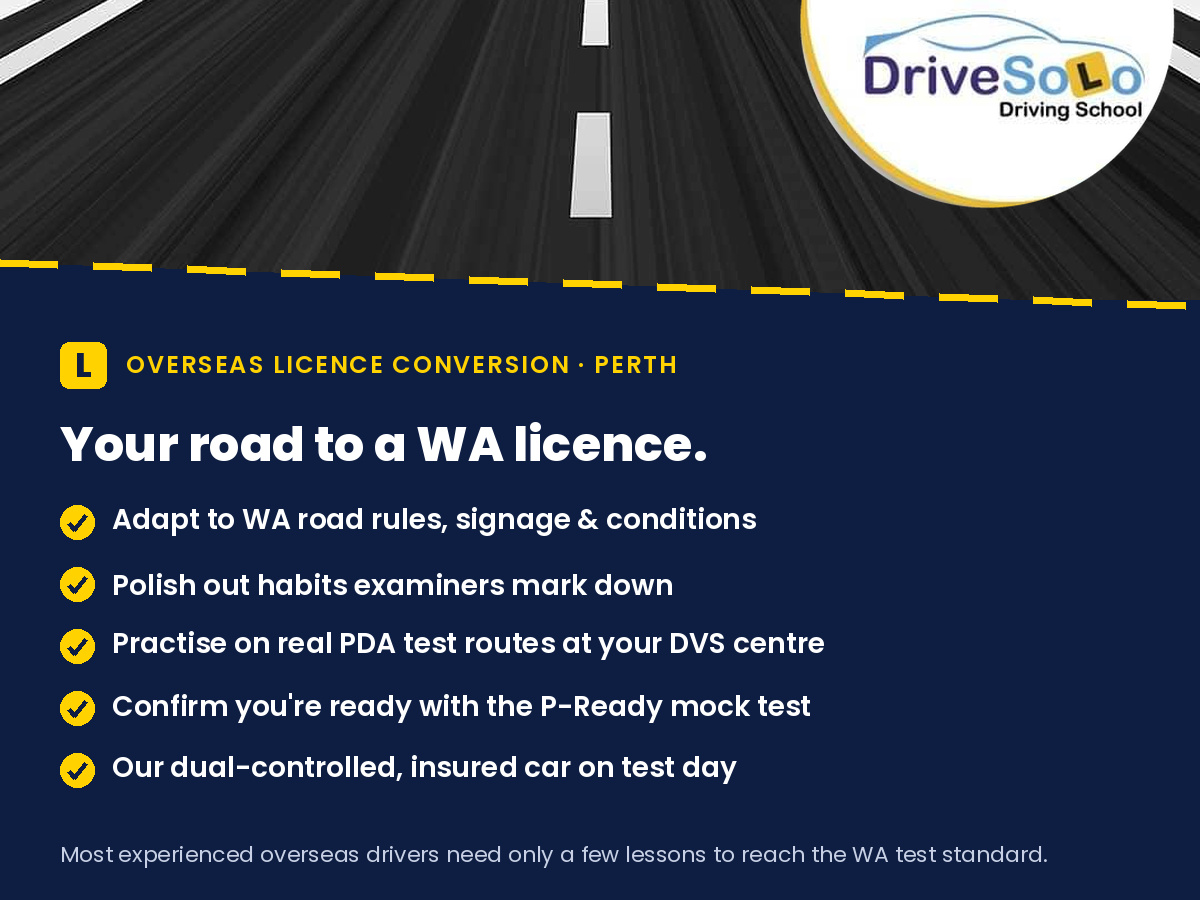
At Drive Solo, lessons are delivered in automatic, dual-control, 5-star ANCAP-rated vehicles with patient instruction centred on current WA road rules and safe, repeatable technique. For overseas drivers, that means building on the experience you already have while addressing the local details that matter most.
How to get more from each lesson
Be open with your instructor about where and how long you have driven. Mention whether you learned in a left-hand or right-hand traffic system, whether you have driven automatic vehicles before, and which situations make you uneasy. This helps them plan a lesson at the right level rather than spending time on skills you already have.
Ask questions as they arise. If a rule seems different from what you know, clarify it straight away. A good instructor will explain the practical reason as well as the rule itself, which makes it easier to recall when you are driving alone.
Between lessons, practise only within the conditions of your licence and at a level that is safe for you. Short, purposeful practice is often more valuable than a long drive where mistakes go uncorrected. Review the feedback from your progress report, choose one or two skills to focus on, and build confidence gradually.
The goal is not to erase your previous driving experience. It is to add the local knowledge, observation habits and calm decision-making that help you drive safely in Perth from the moment you set off on your own.
