


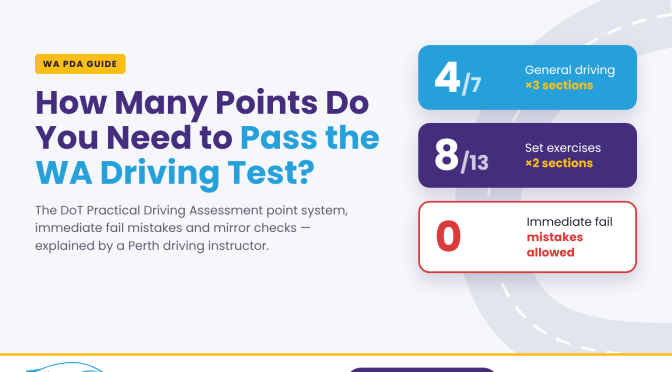
“How many points do I need to pass?” I hear that question from almost every learner I teach, usually a week or two before their test. It makes sense. When you know how the WA Practical Driving Assessment (PDA) is scored, the test stops feeling like a mystery and starts feeling like something you can prepare for.
In this article I’ll walk you through the Department of Transport (DoT) PDA point system the way I explain it in the car: how many points each section is worth, how many you need to pass, the mistakes that end a test on the spot, and why mirror checks can fail you even when your points look fine.
The five sections of the WA driving test
The WA PDA for a car licence is split into five sections. Three of them are general driving, where you simply follow the assessor’s directions. The other two are set exercises: Left Something Behind, and Stopping for Shopping, where you park the car forward and in reverse.
A typical test runs in this order: The WA Practical Driving Assessment (PDA) consists of five sections. To pass, you must successfully complete at least four of the five and avoid any automatic fail items, such as speeding or requiring the assessor to intervene.
| Section | What happens | Points available | Points to pass |
|---|---|---|---|
| 1. General driving | From the DoT centre to a quiet residential street | 7 | 4 |
| 2. Left Something Behind | Pull over, move off, turn around and return | 13 | 8 |
| 3. General driving | From the quiet street to a car park | 7 | 4 |
| 4. Stopping for Shopping | Forward park and reverse park in the car park | 13 | 8 |
| 5. General driving | From the car park back to the DoT centre | 7 | 4 |
Every section is scored against the same seven skills. What changes is how much weight some of those skills carry in the exercises.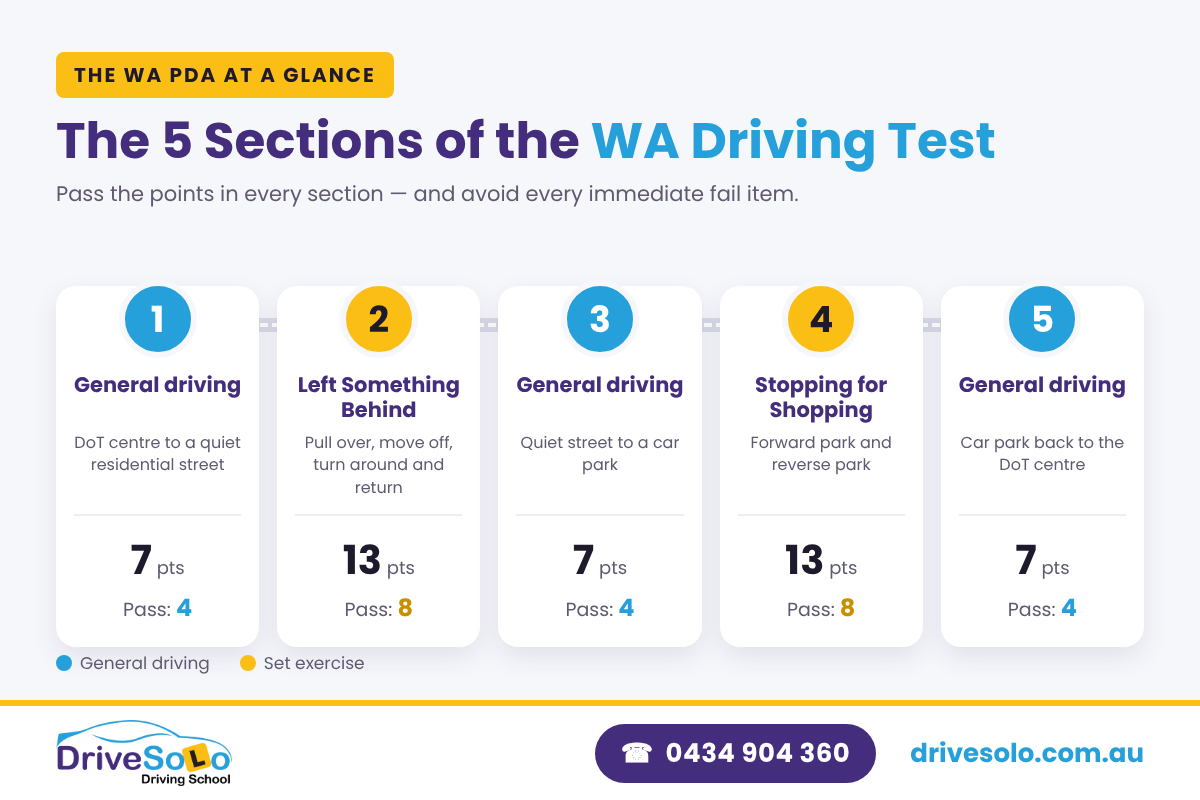
General driving sections: 7 points, 4 to pass
Each of the three general driving sections is worth 7 points, one for each skill the assessor watches:
| Skill | Points | What the assessor is looking for |
|---|---|---|
| Look behind | 1 | Mirror checks and head checks over your shoulder |
| Signal | 1 | Indicating early enough and cancelling it afterwards |
| Flow | 1 | Putting it all together smoothly, without hesitating or holding up traffic |
| Movement | 1 | Smooth acceleration and braking, stopping where you should |
| Path | 1 | Steering, lane position and taking corners on the right line |
| Responsiveness | 1 | Spotting hazards early and adjusting for them |
| Vehicle management | 1 | Seating, steering grip, controls, wipers and lights when needed |
To pass a general driving section, you need at least 4 of those 7 points. So you can drop a point here and there and still be fine. A late indicator at one roundabout won’t end your test.
What I tell my learners is this: don’t drive to scrape through with 4. Nerves will cost you a point or two on the day, so practise until you’re comfortably picking up all 7 on a normal drive.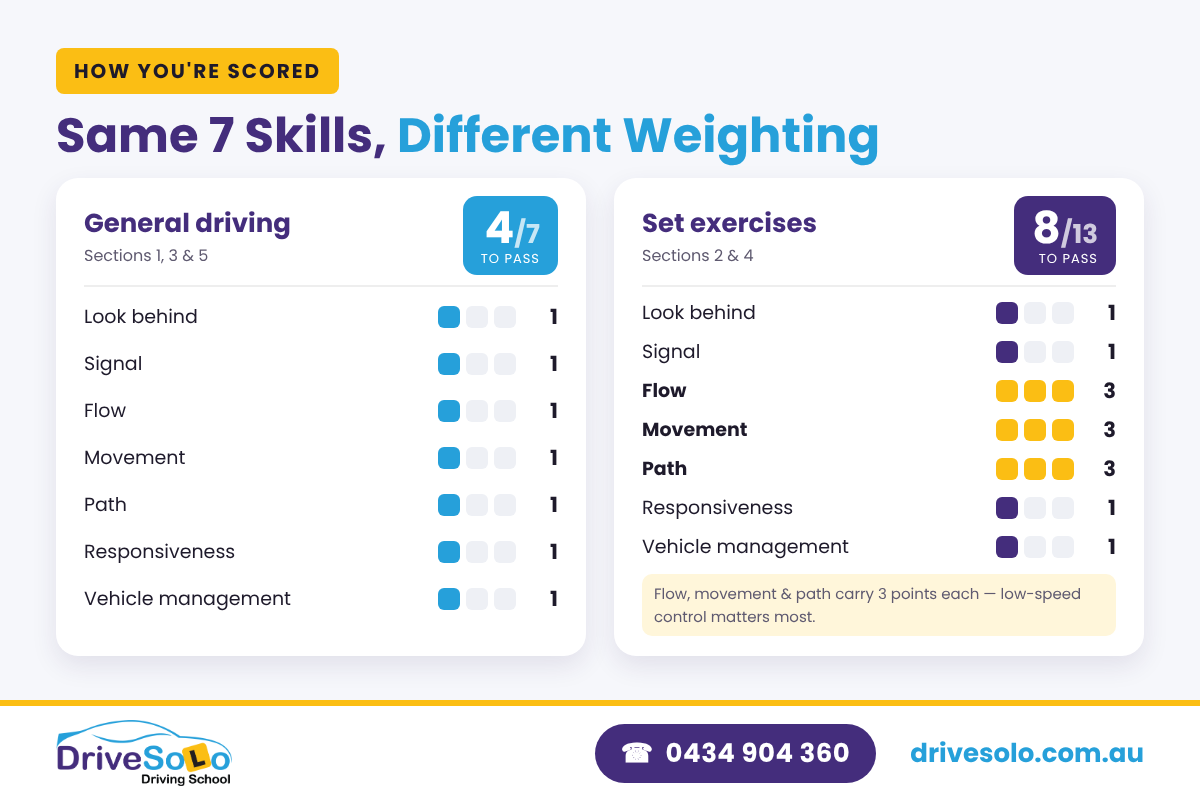
The exercises: 13 points, 8 to pass
Left Something Behind and Stopping for Shopping are scored the same way. Each is worth 13 points, and you need 8 to pass.
| Skill | Points |
|---|---|
| Look behind | 1 |
| Signal | 1 |
| Flow | 3 |
| Movement | 3 |
| Path | 3 |
| Responsiveness | 1 |
| Vehicle management | 1 |
| Total | 13 |
Notice where the weight sits. Flow, movement and path are worth 3 points each because these exercises are all about low-speed control. The assessor wants to see you choose a sensible spot, move the car smoothly at walking pace and put it exactly where it should be.
Left Something Behind
You’ll pull over on a quiet street, then move off. A little further on, the assessor tells you they’ve left something behind. Your job is to turn the car around safely, using a driveway or a U-turn, and head back. Most of the points I see lost here come from a rushed turnaround spot, too little indicator before moving off, or reversing out of a driveway without properly looking behind.
Stopping for Shopping
The assessor directs you into a car park. You’ll do a forward park into a bay, drive out, then find another bay and reverse park. Keep your speed down, watch for people with trolleys and cars backing out, and finish straight and centred in the bay. If you need to adjust, that’s fine, just look behind again before the car moves.
Why mirrors can fail you even with passing points
This is the part I want every learner to read twice. You can reach the passing points in every section and still fail your PDA if you don’t check your mirrors, or check them very rarely.
The reason is simple. A driver who doesn’t know what’s behind them is an unsafe driver, and the assessor’s job is to decide whether you’re safe to drive on your own. Good steering and tidy parking won’t make up for that.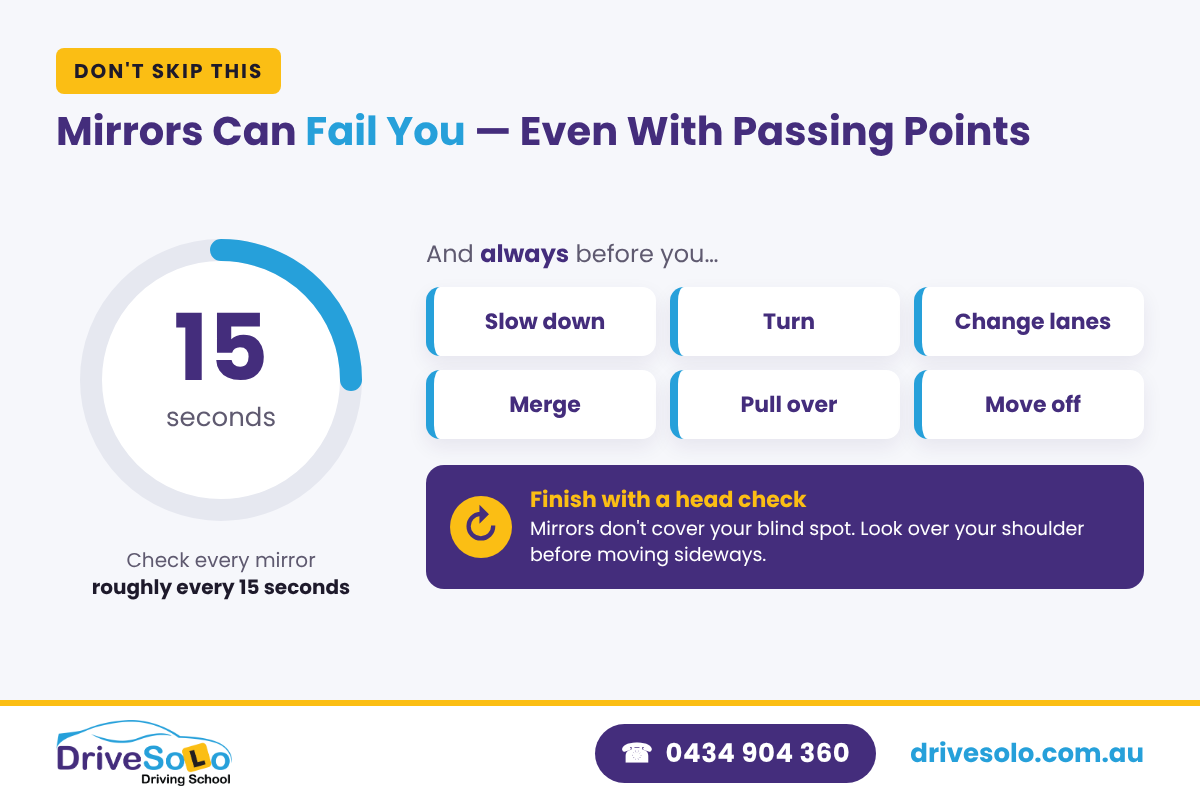
How often should I check my mirrors during the PDA?
This is the most common question I get asked as an instructor. My answer: check every mirror roughly every 15 seconds, and always before you slow down, turn, change lanes, merge, pull over or move off.
Keep each check quick. A glance gives you the information you need without taking your eyes off the road ahead for too long. And remember that mirrors don’t cover your blind spot. Before you move sideways, whether you’re leaving the kerb or changing lanes, finish with a head check over your shoulder.
If mirror checks don’t feel natural yet, practise them on every drive until you do them without thinking. That’s exactly what the assessor wants to see.
What is an immediate fail in the WA driving test?
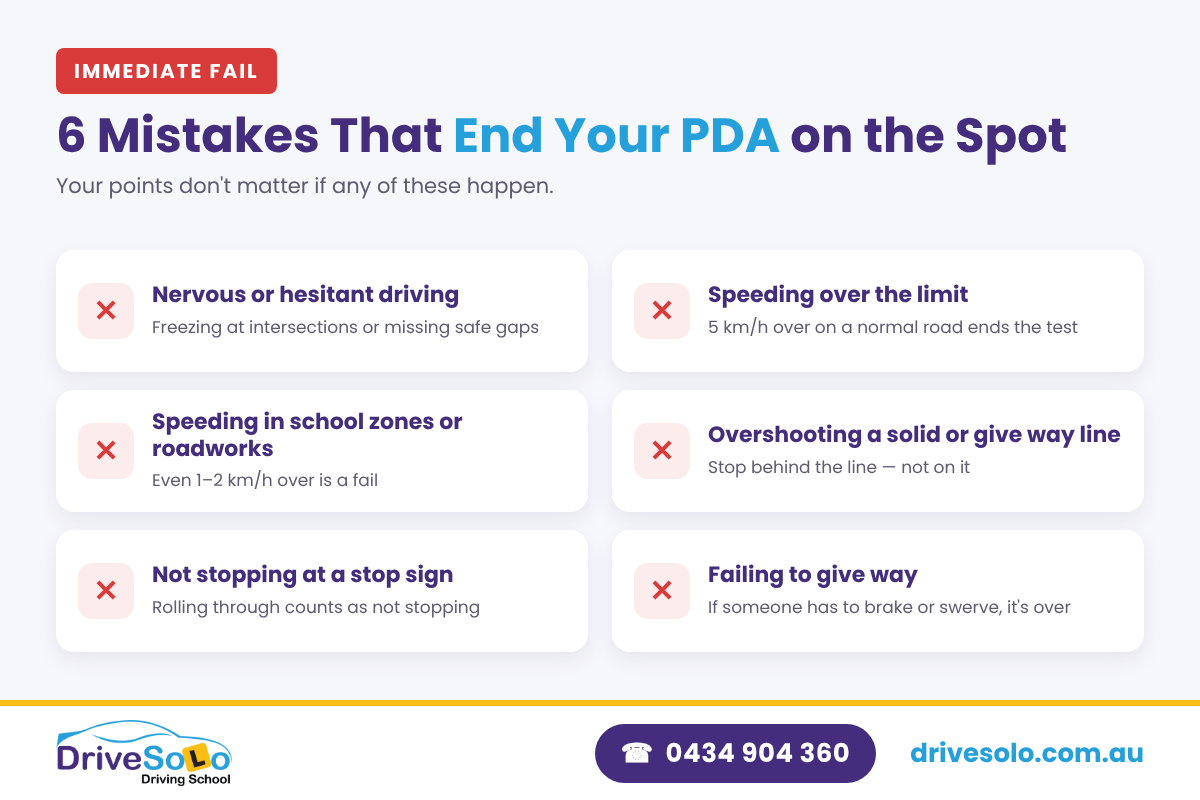
The second question learners ask me most is what ends a PDA on the spot. Points don’t matter if any of these happen:
- Nervous or hesitant driving. A driver who freezes at intersections, misses safe gaps or can’t commit to a decision fails fast, because hesitation creates danger for everyone around you.
- Speeding over the legal limit. This is the second most common cause of an immediate fail I see.
- Speeding in a school zone or roadworks. Treated even more strictly than normal roads (more on this below).
- Overshooting a solid line or a give way line. The front of your car should stop behind the line, not on it or over it.
- Not stopping at a stop sign. Rolling through counts as not stopping. Come to a complete stop every time.
- Failing to give way. If someone else has right of way and has to brake or swerve because of you, your test is over.

The speeding rule
On a normal road, in my experience, drifting one or two km/h over the limit for a moment won’t end your test on its own. Going 5 km/h over the legal limit will. That’s an immediate fail and the end of your PDA.
School zones and roadworks zones are different. Because children and workers are close to the road, even one or two km/h over is treated as dangerous driving and is an immediate fail.
Please don’t read this as a buffer to play with. The Department of Transport lists speeding as a fail item, and the safest plan is to sit just under every limit and keep an eye on your speedometer, especially as you come out of a turn or down a hill.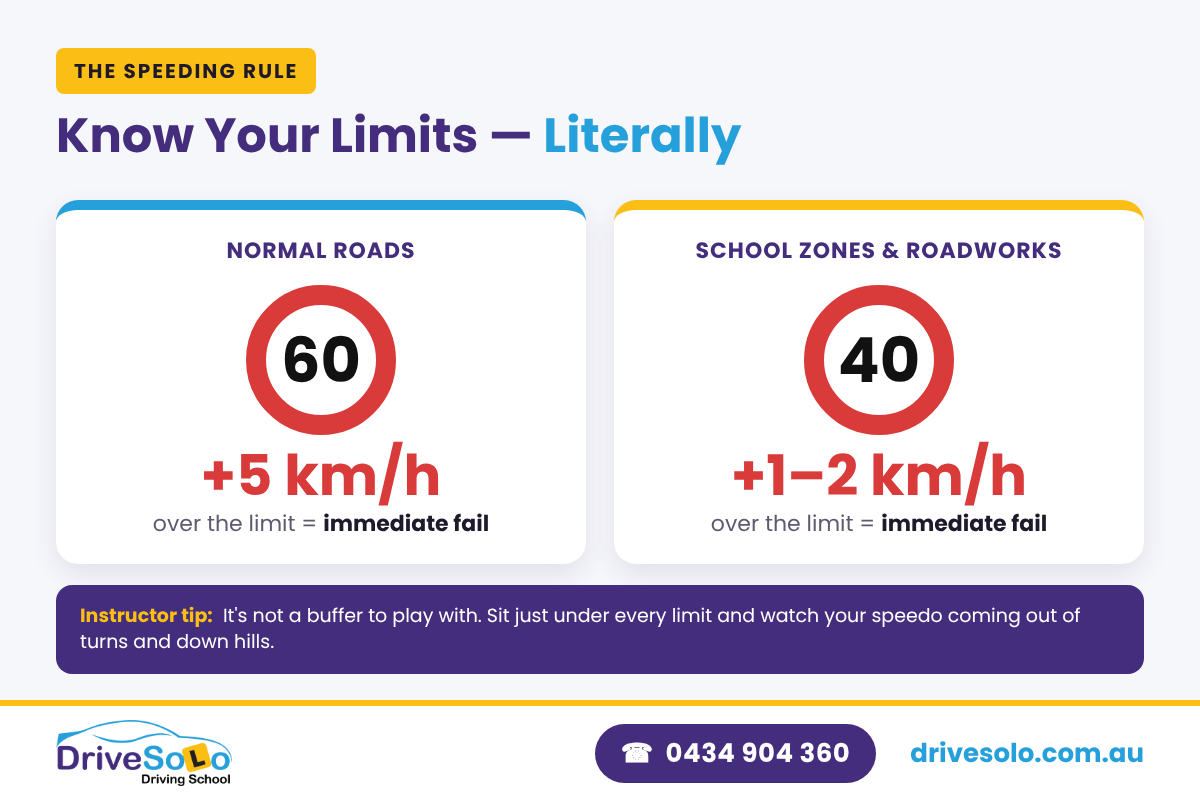
Why overseas drivers fail the PDA
I teach a lot of experienced drivers from overseas, and many of them are genuinely good drivers. When they fail, it’s rarely about car control. It’s usually because they aren’t sure of their obligations on WA roads.
The most common example is giving way when they don’t need to. Stopping for a car that should be giving way to you might feel polite, but it confuses other drivers, holds up traffic and costs you points for flow and responsiveness. On the test, the assessor wants to see you know the give way rules and act on them confidently.
The other big one is skipping road signs and not following the road markings. Lane arrows, solid lines, keep left signs and school zone signs all mean something specific here, and a habit from back home can easily lead to a fail item.
If you’ve driven for years in another country, a few lessons focused on WA road rules and the PDA routes can make all the difference.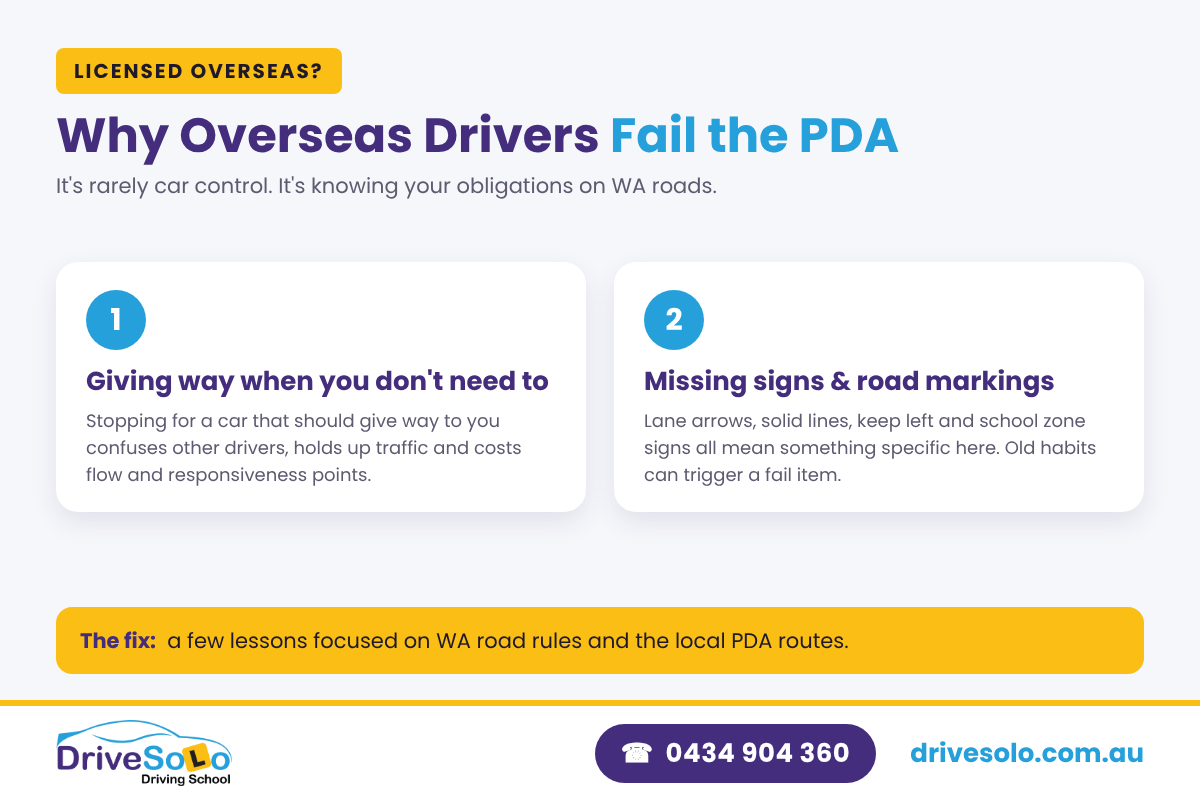
Prepare for your PDA with Drive Solo
Knowing the point system takes a lot of the fear out of test day. You don’t need a perfect drive. You need to pass 4 sections out 5 to overall pass the WA Practical Driving Test. You need at least 4 out of 7 in each general driving section, at least 8 out of 13 in each exercise, steady mirror checks the whole way, and none of the immediate fail mistakes.
At Drive Solo, I teach learners on real Perth roads across the southern suburbs, so you get used to the kind of streets, roundabouts and car parks you’ll see on the day. We’ll work through both exercises, build a natural mirror and head check routine, and make sure you know exactly where your points are coming from.
Ready to book a lesson? Call Drive Solo on 0434 904 360.
