


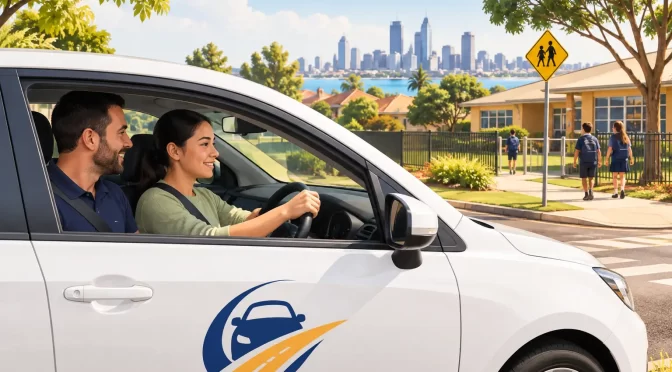
A school zone can look quiet one minute and become unpredictable the next. A child may step off the kerb to meet a parent, a car may reverse from a bay, or a cyclist may appear beside parked vehicles. Knowing how to approach school zones is not just about spotting a 40 km/h sign. It is about slowing your thinking down before the busy area begins.
For learner drivers, school zones are also a valuable test of observation, speed control and hazard awareness. These are the same safe habits expected on the WA Practical Driving Assessment and, more importantly, on every school-day drive after you receive your licence.
How to approach school zones with control
The best approach starts before you reach the school gate. Scan well ahead for school-zone signs, flashing lights, children’s crossings, buses, parked cars and people waiting near the kerb. Do not wait until you are alongside the sign to react.
Ease off the accelerator early and brake progressively so you enter the zone at the posted limit, rather than braking sharply at the last moment. In Western Australia, school-zone limits and their operating times are shown on the signs. Read the signs each time you enter a zone. Do not rely on memory, a previous route or assumptions about school holidays.
Many WA school zones have a 40 km/h limit during the times displayed. When the lower limit applies, it applies from the sign, so have your speed under control before you pass it. Check your speedometer after slowing down. On a slight downhill section, it is easy for an automatic car to gradually gather speed without you noticing.
A calm, early reduction in speed gives you more time to see, decide and respond. It also gives drivers behind you a clear signal that traffic conditions are changing.
Read the road, not only the signs
Speed signs set the legal limit, but the safest speed can be lower when visibility or activity demands it. A 40 km/h zone with clear footpaths and no pedestrians is different from a wet afternoon when families, buses, prams and children are gathered at the crossing.
Keep scanning from side to side. Look between parked cars, at driveway exits, along the footpath and towards crossing attendants. Children can be difficult to see because they are smaller than adults, and they may change direction quickly. A ball rolling into the road, a child looking back at friends or a parent calling from the other side are all clues that someone may enter your path.
Avoid focusing only on the car directly ahead. Maintain a safe following distance so you can see around it where possible and stop if it brakes suddenly. In school traffic, vehicles often stop without much warning as passengers get in or out, or as a pedestrian approaches a crossing.
Be especially careful around parked vehicles
Parked cars create blind spots. A child can emerge from between them with little warning, while a parent may open a door into the road or begin reversing from a parking space. Move through these areas slowly, keep your eyes active and be prepared to stop.
Do not drive too close to parked vehicles. Give them reasonable clearance where the road allows, while staying within your lane and watching for oncoming traffic. If there is not enough room to safely pass a vehicle or obstruction, wait rather than squeezing through.
This is also why phone use is so dangerous near schools. Looking away for even a moment can mean missing the first sign of a hazard. Put your mobile away before you start driving and keep your full attention on the road.
Handle crossings patiently and correctly
School crossings require deliberate observation. As you approach, look for people waiting to cross as well as people already on the road. Check the crossing area, the footpaths on both sides and the movement of nearby traffic.
If a crossing attendant is present, follow their directions. Slow down early enough that you can stop smoothly if required, and never try to rush through because the person has only just stepped onto the crossing. People crossing with young children may move more slowly than expected.
At any pedestrian crossing, do not overtake a vehicle that has stopped or is stopping. It may be giving way to a pedestrian you cannot see. Treat the stopped vehicle as information: something ahead needs your attention.
After people have crossed, check the full area again before moving off. A second child, sibling or family member may follow behind them. This extra check takes less than a second and can prevent a serious mistake.
Expect busy drop-off and pick-up behaviour
The busiest school periods can bring rushed and imperfect driving from otherwise careful people. Cars may queue, perform U-turns, stop briefly in places that block your view or pull out from the kerb unexpectedly. Your job is not to predict every action perfectly. Your job is to leave room and time for the unexpected.
Keep a generous gap from the vehicle in front, particularly in a queue. This helps you see brake lights earlier and avoids feeling pressured to creep forward into a crossing or intersection. If a driver behind you is impatient, do not let them rush you. Maintain the appropriate speed and make safe decisions.
Watch for buses as well. Children may cross near the front or rear of a bus, where they are hidden from your view. Slow down, scan carefully and be prepared to stop. Never assume that a clear lane beside a bus means the area is clear of pedestrians.
When you are being picked up or dropped off, choose a legal, safe place rather than stopping in a way that forces children to cross between cars. Families can make school runs safer by leaving a few extra minutes, using designated areas where available and keeping farewells organised before opening the car door.
Use the right driving routine
A reliable routine keeps your actions controlled when there is a lot to process. As you see a school-zone sign ahead, check your mirrors, ease off the accelerator, brake gently if needed and confirm your speed. Then scan the road edges, crossings and gaps between parked vehicles.
If you need to stop, brake smoothly and keep your vehicle positioned correctly. Before moving again, check your mirrors and look ahead for pedestrians, cyclists and vehicles pulling out. If you need to change lanes around a parked car, use the full observation routine: mirrors, indicator, head check, then move only when it is safe.
Learners sometimes concentrate so hard on the speed limit that they forget steering position, mirror checks or following distance. Others look everywhere except their speedometer and accidentally exceed the limit. Good driving is a balance. Keep the car steady, keep your speed appropriate and keep looking for hazards.
What assessors and instructors want to see
On a Practical Driving Assessment, a school zone is not a place to perform a memorised routine. It is a real traffic environment where your judgement matters. An assessor will expect you to identify the signs, comply with the speed limit, observe carefully and respond safely to people and traffic around you.
Braking late, driving at the wrong speed, failing to notice a pedestrian or following another vehicle too closely can all show that your observation and hazard management need more work. Equally, driving far below the limit when the road is clear can interrupt traffic and may indicate uncertainty. The right choice depends on the posted limit, visibility, weather and the activity around the school.
Practising on familiar local routes helps, but do not let familiarity make you complacent. A school zone in Cockburn, Fremantle or Rockingham can change quickly depending on the time of day, road layout and parking conditions. Professional lessons can help you identify the small habits that informal practice may miss, such as checking speed after a downhill approach or scanning behind a bus before moving on.
Build confidence before your next school-zone drive
If school zones make you nervous, start by practising outside the busiest times with a qualified supervisor. Learn where the signs begin and end, notice the crossing locations and practise reducing speed smoothly. Then build up to busier sessions once your steering, braking and observation routine feels natural.
Drive Solo instructors use real-road practice to correct specific errors as they happen, so learners can understand not only what to do, but why it protects people around them. That level of feedback is particularly useful before a PDA, when safe habits need to be repeatable rather than occasional.
The goal is simple: approach every school zone as a place where someone may need your patience. A few seconds of extra care gives children, families and you the space to get home safely.
