


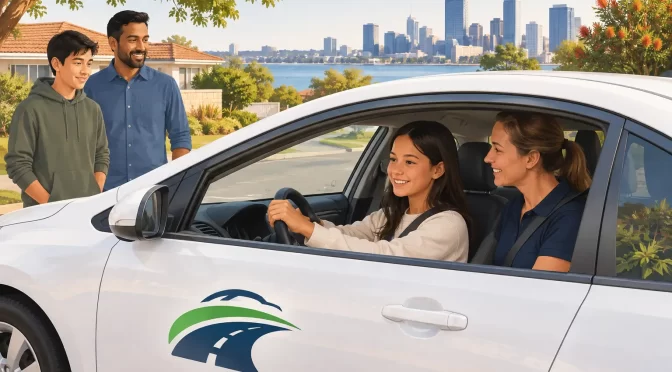
A learner can complete a familiar trip to school without much trouble, then freeze when traffic builds at a busy roundabout or a gap closes during a lane change. That is the real teen driver case for professional lessons: young drivers need more than time behind the wheel. They need calm, accurate coaching that turns each decision into a safe, repeatable habit.
For parents, teaching a teenager to drive can be a meaningful responsibility. It can also be stressful. You are trying to watch the road, explain an unfamiliar manoeuvre, manage your own nerves and keep your child confident at the same time. Professional tuition does not replace parental practice. It gives that practice a safer structure and helps families focus on building experience rather than arguing over every correction.
Why a teen driver needs more than kilometres
Hours on the road matter, but kilometres alone do not teach a learner what they missed. A teenager may steer smoothly and still fail to scan properly before moving off. They may know the speed limit but approach a hazard too quickly. They may complete a reverse park in an empty car park, yet lose position, observation or control when there are pedestrians, traffic and pressure around them.
New drivers are still developing the ability to read risk early. That includes noticing a vehicle waiting to turn, checking for cyclists before opening a door, allowing space behind a heavy vehicle and recognising when a green light may change. These are not dramatic skills. They are the everyday choices that reduce the chance of a serious mistake.
A qualified driving instructor watches for patterns rather than isolated errors. If a learner repeatedly brakes late, drifts wide on turns or misses mirror checks, the instructor can identify why it is happening and use a clear correction method. The learner then has a practical action to use next time, not simply a reminder to “be more careful”.
The value of a neutral, trained coach
Parents often know their child best, but that closeness can make feedback harder to hear. A quick “slow down” may sound like criticism to a nervous learner, especially after a difficult day at school or work. Equally, a parent may overlook a habit because it has become familiar during short local drives.
A professional instructor provides a neutral second set of eyes. Lessons are built around the learner’s current ability, with feedback delivered in the moment and explained afterwards. The goal is not to overload a teenager with instructions. It is to help them understand what happened, what a safer choice looks like and how to practise it independently.
This is particularly useful when a learner has picked up conflicting advice. Families may have driven for decades without thinking about the exact sequence of mirror checks, head checks, signalling, speed adjustment and road positioning. Current WA road rules and Practical Driving Assessment expectations require those actions to be demonstrated consistently. An instructor can teach the correct routine clearly, without turning every drive into a debate.
Safety equipment supports better learning
Learning is easier when everyone in the car feels protected. A properly maintained training vehicle with dual controls gives an instructor the ability to intervene if a situation develops too quickly. That does not encourage risk-taking. It gives learners room to encounter real traffic conditions under close supervision, while reducing pressure on both the learner and their family.
A modern, fully insured vehicle also removes practical hurdles. Learners can focus on steering, observation, braking and road awareness rather than worrying about damaging the family car. For many parents, that reassurance is a sensible part of the teen driver case for professional lessons.
Preparing for the WA Practical Driving Assessment properly
A driving test is not simply a test of whether a learner can park. The WA Practical Driving Assessment looks at safe, lawful and controlled driving over a range of normal road situations. Assessors are looking for decisions that show awareness, not rehearsed tricks.
That is why test preparation should begin well before test day. A learner who only practises a route may cope if conditions stay predictable, but roads rarely do. A delivery van can block the view at an intersection. A pedestrian can step near a crossing. A driver in front can brake unexpectedly. Safe drivers respond by looking ahead, managing speed and keeping enough space to act.
Professional lessons can familiarise learners with the standard expected in the assessment while keeping the focus on genuine driving skill. That includes moving off safely, approaching intersections, changing lanes, managing roundabouts, reversing, parking, responding to signs and maintaining appropriate road position. Just as importantly, learners receive direct feedback on small faults before those faults become test-day errors.
It depends on the learner how many lessons are useful. Someone who has regular, calm family practice may need targeted support to refine observation and prepare for the assessment. Someone starting with little experience, a lack of confidence or inconsistent habits may benefit from a more structured lesson plan. Progress reports help make that decision based on demonstrated skills, rather than guesswork.
How parents can make home practice count
Professional instruction works best alongside regular supervised driving. Parents do not need to repeat an instructor’s lesson word for word. Their role is to provide steady practice in a calm environment, allowing the learner to apply what they have been taught.
Choose drives that match the learner’s stage. Early sessions may suit quiet streets, simple turns and controlled parking. As confidence grows, add roundabouts, busier shopping areas, higher-speed roads, night driving and wet-weather conditions where safe to do so. Repeating the same easy route can build comfort, but varied driving builds judgement.
Before leaving, agree on one or two priorities. For example, a learner may focus on checking mirrors early and slowing before turns. Keeping the goal small makes feedback more useful. At the end of the drive, ask what felt difficult and what they would change next time. This encourages self-assessment, which is essential once they are driving independently.
Try to avoid giving a stream of directions at the last second. Clear, early instructions are safer and less stressful. If either person is tired, frustrated or distracted, it is reasonable to stop and try again another day. A productive driving session does not need to be long, but it does need to be focused.
Confidence should come from capability
A teen who says they are ready to drive alone may mean they feel comfortable operating the car. Genuine readiness is broader. It means they can stay composed when another road user behaves unpredictably, make safe choices without being prompted and accept that arriving a few minutes later is better than taking a rushed risk.
Confidence built on capability is different from confidence built on familiarity. A learner who has only driven with a parent on quiet roads may feel comfortable, but still be unprepared for peak-hour traffic, an unfamiliar suburb or driving after dark. Gradual exposure, supported by technical feedback, helps close that gap.
At Drive Solo, the focus is on giving learners practical corrections they can carry into every drive, not merely helping them memorise a test route. With patient individual tuition, dual-control vehicles and preparation that reflects current WA assessment expectations, learners can build the skills their families want to see long after the licence is issued.
The best time to address a risky habit is while it is still a learning moment. Give your teenager space to practise, qualified guidance when they need it and the time to become the calm, observant driver they will need to be on every road ahead.
