



The first few times behind the wheel can feel like there is too much to watch at once: the speedometer, mirrors, traffic lights, cyclists, parked cars and the vehicle in front. Automatic driving lessons for beginners reduce that pressure by removing gear changes from the equation, so you can give proper attention to observation, judgement and safe road position.
For many Perth learners, an automatic is the practical place to start. The car is simpler to operate, but safe driving is never simply about moving the vehicle. It is about making sound decisions early enough to protect yourself, your passengers and everyone sharing the road.
Why automatic lessons suit many new drivers
An automatic car lets a beginner focus on the driving environment rather than coordinating a clutch, gears and accelerator at the same time. With your left foot resting and the transmission managing gear selection, there is more mental space to build the habits that matter on real WA roads.
That includes checking mirrors before changing speed or direction, scanning well ahead for hazards, judging safe gaps, maintaining a safe following distance and approaching intersections with a plan. These are the skills that prevent rushed decisions when traffic becomes busy.
Automatic lessons can also help nervous learners settle sooner. That does not mean every lesson is easy. Roundabouts, lane changes, busy shopping-centre car parks and right turns across traffic still require calm, accurate decision-making. The benefit is that an instructor can teach one skill at a time without a stalled engine or missed gear adding to the stress.
An automatic licence is not the right choice for every person. If you expect to drive manual vehicles for work, family or future travel, learning manual may offer greater flexibility. But if your likely vehicle is automatic, choosing automatic lessons is a sensible way to gain confidence and develop safe habits in the car you will actually drive.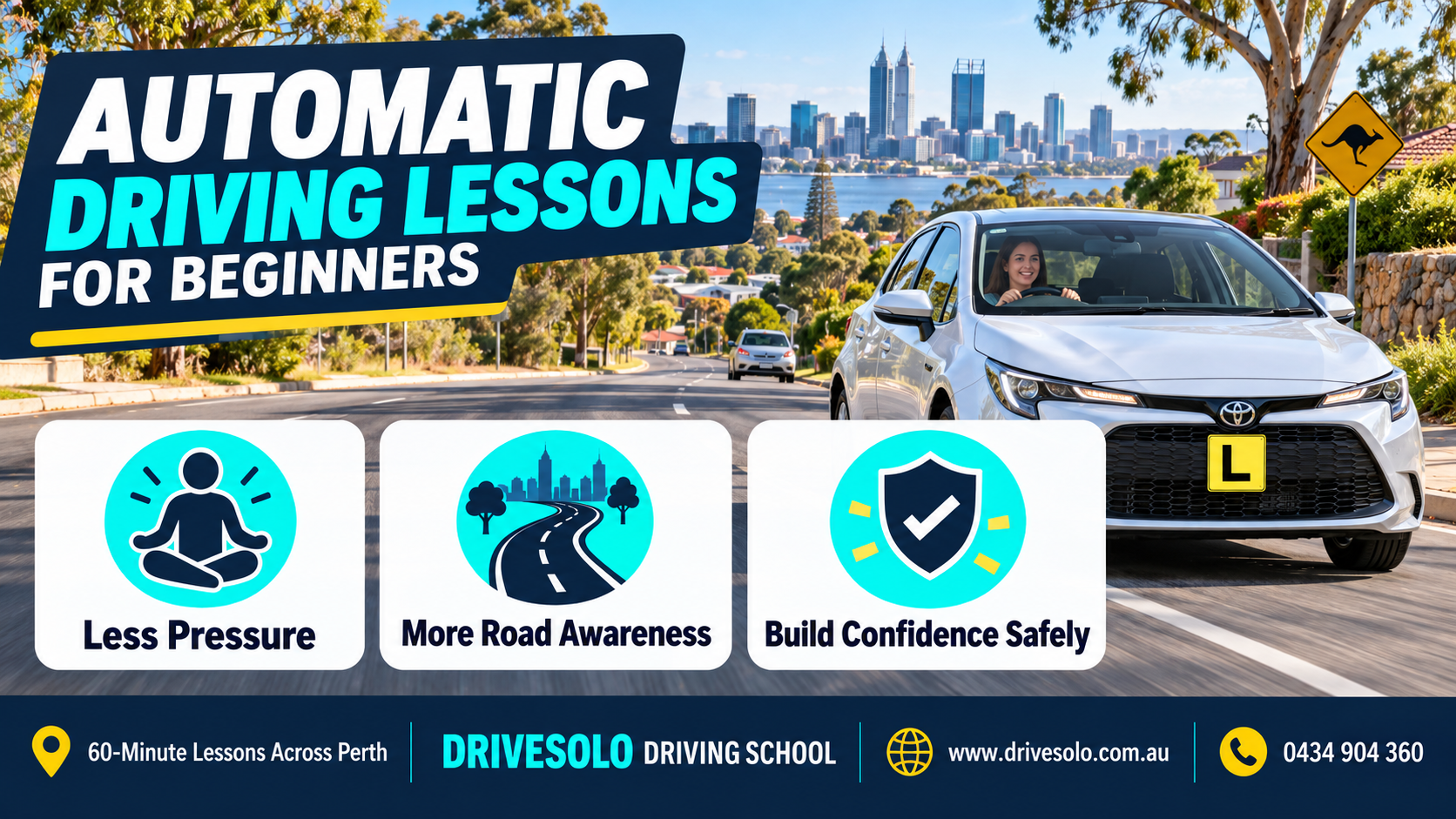
What beginners should learn before worrying about the test
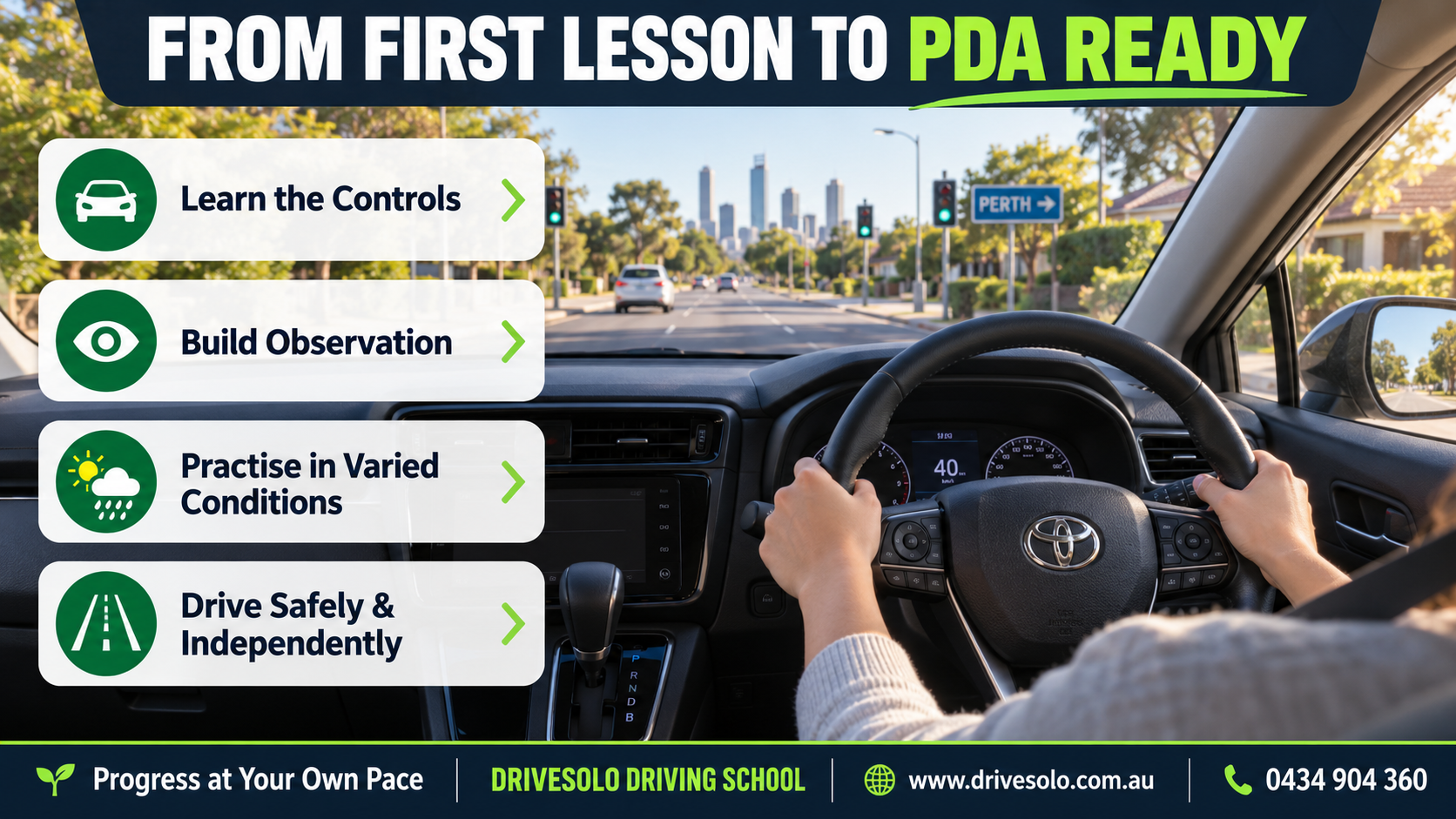
A licence test has clear standards, but a learner who only practises a test route is not necessarily ready for independent driving. Good instruction starts with vehicle control, then builds the observation and judgement needed to deal with unfamiliar roads.
Early lessons should cover setting up the seat, steering wheel and mirrors correctly, using the controls without looking down, smooth braking and acceleration, and steering with consistent road position. These foundations can appear basic, yet poor set-up or harsh braking often creates problems later when traffic is moving faster.
From there, learners need repeated practice with the routines behind safe decisions. Before moving off, changing lanes, turning or pulling over, you need to observe properly, signal where required and position the car safely. The actions should become deliberate rather than rushed. A patient instructor can spot whether a learner is checking a mirror without really processing what is there, which is a common early mistake.
Building awareness, not just confidence
Confidence is useful only when it is matched by awareness. A learner may feel comfortable driving along a quiet suburban street but become uncertain when the road narrows, a bus stops ahead or a pedestrian approaches a crossing.
Professional lessons introduce these situations gradually. You might begin in quieter streets, then practise busier intersections, multi-lane roads, roundabouts, hill starts, reversing and parking as your ability develops. Each new environment gives you a chance to apply the same core routine under slightly more pressure.
This is also where formal training differs from a casual drive with a parent or sibling. Family members can provide valuable supervised practice, but they may not always explain a mistake clearly or know the current WA assessment expectations. An experienced instructor can identify the cause of an error, demonstrate the correction and give you a practical way to repeat it next time.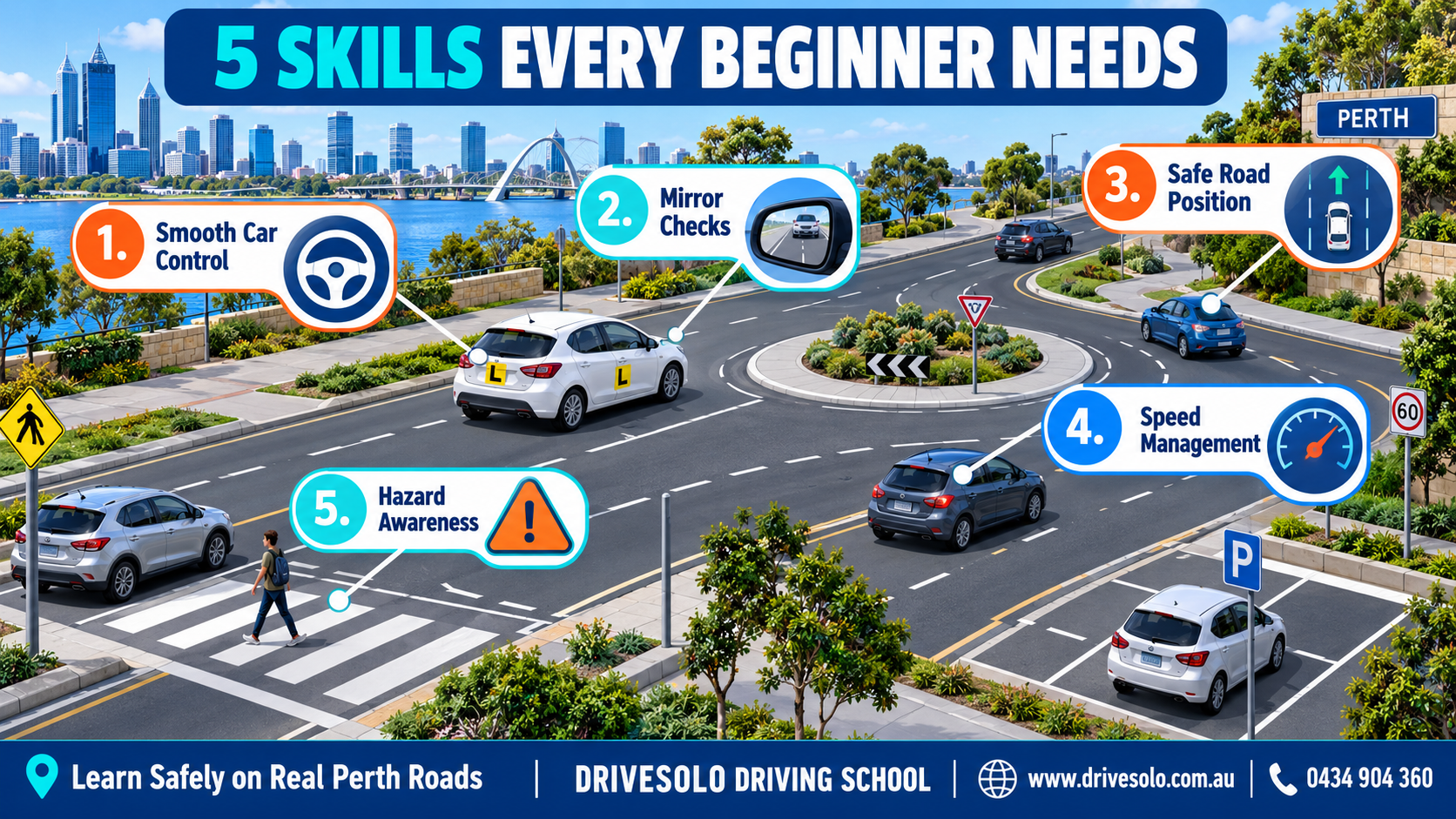
Learning to manage speed properly
New drivers often focus on staying below the speed limit, which matters, but speed management is broader than that. You need to select a speed that suits rain, visibility, traffic flow, pedestrians, road surface and the space ahead.
For example, travelling at the posted limit may still be inappropriate when cars are parked tightly on both sides of a residential street. Reducing speed gives you time to react if a child, dog or opening car door appears. A beginner should learn to look far enough ahead to ease off early instead of braking sharply at the last second.
How many automatic driving lessons do beginners need?
There is no honest one-size-fits-all number. Some learners have regular supervised practice and quickly become consistent. Others are balancing school, work, nerves or limited access to a car. The right number of lessons depends on your starting point, how often you practise between lessons and whether you can perform safely in different conditions rather than only on familiar streets.
In Western Australia, learners must meet supervised driving-hour requirements before sitting the Practical Driving Assessment, including required night driving. Those hours are valuable when they are purposeful. Repeating the same short route may make you comfortable with that route, but it will not necessarily prepare you for a busy roundabout, wet roads after dark or an unfamiliar parking area.
A good approach is to use professional lessons to establish correct technique, then reinforce it with supervised practice. Your instructor can give specific priorities for the next drives, such as smoother braking, earlier mirror checks or safer approach speeds at intersections. This makes home practice more productive and helps families avoid conflicting advice.
Learner progress reports are particularly useful here. They show what has been covered, what is improving and which skills still need attention. For parents, that creates reassurance that lessons are building towards measurable safe-driving capability, not simply filling logbook hours.
Preparing for the WA Practical Driving Assessment
The WA PDA assesses whether you can drive safely, independently and consistently. It is not about performing a perfect routine under pressure or guessing what the assessor wants. You need to show sound observation, appropriate speed, vehicle control, road positioning and compliance with road rules throughout the drive.
Preparation should include the manoeuvres and situations you may be assessed on, but the focus must remain on understanding the reason behind each action. When reversing, for example, effective observation matters more than rushing to finish the manoeuvre. When changing lanes, a signal alone is not enough – you must check that the space is safe and move only when it is safe to do so.
Test-day nerves are normal, especially for younger learners. They are easier to manage when the process is familiar. A lesson before the assessment can help you settle into the vehicle, refresh key routines and identify any last-minute issues without trying to learn new skills. Using the same dual-control, fully insured vehicle you have practised in can remove one more unknown from the day.
Choosing an instructor and vehicle for beginner lessons
The first instructor you choose can shape how a learner feels about driving. Look for a licensed, police-checked instructor who communicates calmly, explains corrections clearly and teaches current WA road rules. The vehicle also matters. A well-maintained automatic car with dual controls gives the instructor an extra safety safeguard while you are still learning to judge traffic and brake smoothly.
Convenience makes consistent practice more realistic. Free pick-up and drop-off from home, school or work can be particularly helpful for busy students and working learners, while weekend and night lessons allow skills to be built in conditions that daytime-only practice may miss.
Drive Solo provides 60-minute automatic lessons across Perth’s southern suburbs, with individual coaching, progress tracking and transparent all-inclusive pricing. More importantly, the lesson should be paced around the learner in the seat. Some people need extra time to become comfortable with steering and braking; others are ready to work on complex traffic situations sooner.
Make every lesson count
Come to each lesson ready to discuss what felt difficult during your last practice drive. Maybe you hesitated at roundabouts, forgot mirror checks when pulling over or felt unsure about judging gaps. These details give your instructor something real to work with.
Wear suitable shoes, avoid arriving overly tired, and let the instructor know if you are anxious or have not driven for a while. There is no benefit in pretending you are more confident than you feel. Honest communication lets the lesson stay safe, useful and appropriately challenging.
The goal is not to rush towards a pass date. It is to reach the point where you can drive with steady attention when no instructor, parent or assessor is there to prompt you. That is the confidence worth taking onto the road.
